マシンビジョンピープルの未来ブログ

Road safety remains a major public challenge. The World Health Organization estimates that approximately 1.19 million people die each year in road traffic crashes worldwide, while the United States recorded around 39,254 traffic fatalities in 2024, according to NHTSA.

Road authorities face growing pressure to expand enforcement coverage, but budgets remain tight, qualified personnel are scarce, and the infrastructure needed for large-scale enforcement is complex. Traditional approaches, such as assigning officers to operate speed cameras manually, do not scale.

This article explains how modern managed traffic enforcement programs work, from the detection technology on the roadside through violation processing and program oversight. It is written for professionals who evaluate, procure, or oversee enforcement programs.

What is managed traffic enforcement?

Managed traffic enforcement is an end-to-end program model in which a specialist partner provides detection technology, system integration, violation processing, equipment maintenance, reporting, and compliance services under a single contract. This enables road authorities to deploy reliable, legally defensible enforcement across their jurisdiction without building and staffing in-house infrastructure.

In practice, that means the authority retains policy control, oversight, and accountability, while the operating partner manages the day-to-day delivery of the program. This model differs fundamentally from a hardware-only purchase. Instead of buying an automated speed enforcement camera or back-office software as separate elements, the authority receives a coordinated service with defined service levels, technical support, and operational continuity.

For road authorities facing staffing shortages, procurement pressure, or the need to expand traffic law enforcement coverage quickly, the managed model can reduce operational complexity while improving consistency across the full enforcement chain.

Core components of a managed traffic enforcement program

Whether operated in-house or through a managed partner, every effective enforcement program consists of five interrelated components:

1. Detection technology

The first component is roadside detection. Depending on the use case, radar or lidar sensors are used. In traffic enforcement, measurement precision is central because every case depends on reliable, court-defensible evidence. The detection layer must identify the vehicle, measure the relevant violation, and create the basis for a complete evidence package. Today AI‑based analysis increasingly turns the collected data into actionable insights for smarter and safer traffic management.

2. Violation processing and evidence management

Detection alone does not create an enforceable case. The captured event must be converted into structured evidence. That includes images, measured values, time-stamps, location data, and system records. The evidence package must remain complete, traceable, and tamper-evident throughout the process. In managed programs, the partner operates a back-office that reviews, validates, and packages each violation before it reaches the adjudication authority.

3. Data management and back-office integration

Managed traffic enforcement systems rely on strong data flows between roadside technology and the back-office. The program must support secure transmission, case creation, review workflows, notice generation, and interfaces to payment, court, or agency systems where required. Without this operational backbone, even precise field technology creates unnecessary friction.

4. Deployment models

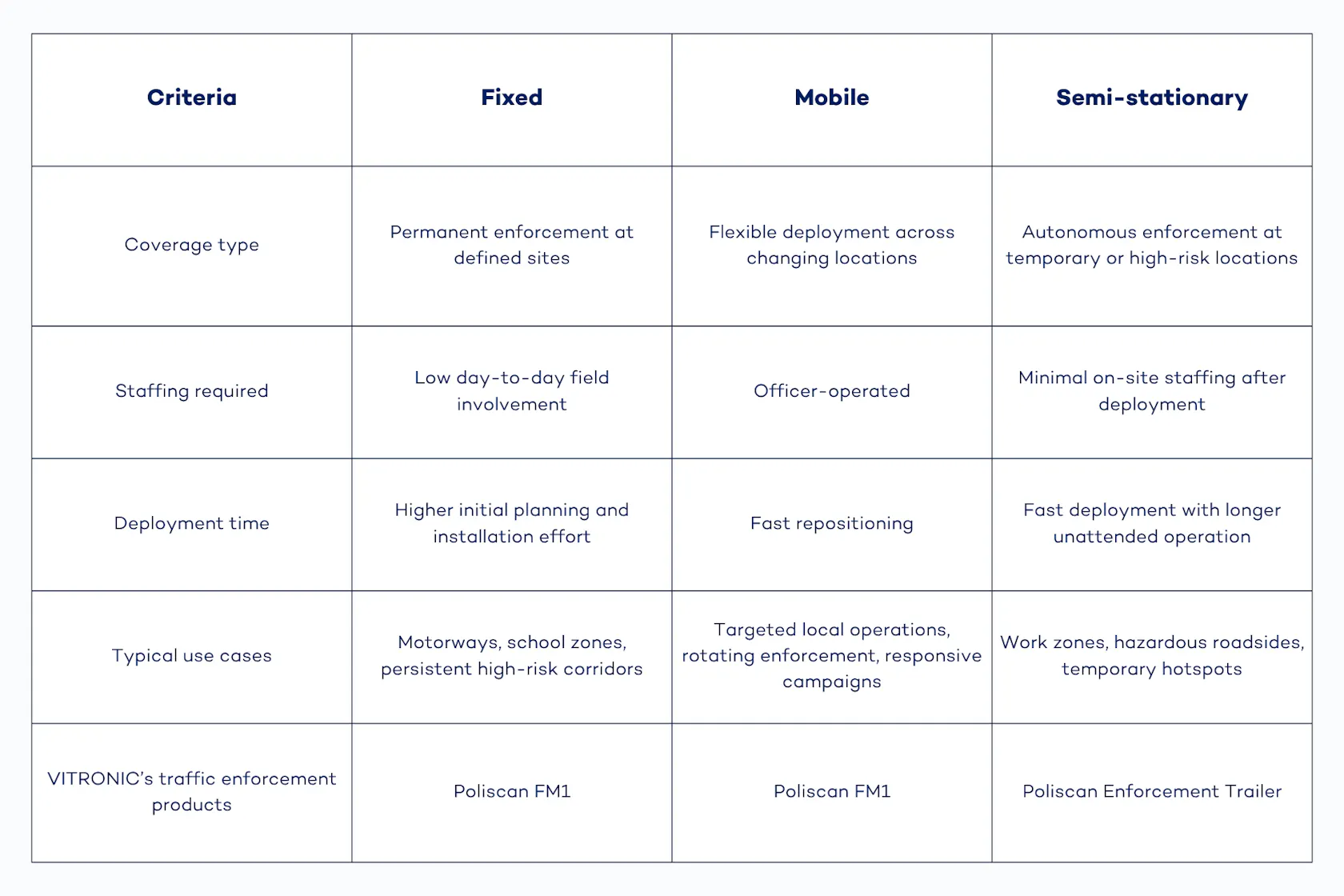
Road authorities usually need more than one deployment model. Fixed systems provide continuous enforcement at permanent sites. Mobile systems support flexible deployment by officers. Semi-stationary systems such as enforcement trailers enable autonomous operation in hazardous or changing locations. The right mix depends on the road network, risk profile, staffing model, and community priorities.

5. Program oversight and reporting

A mature program includes oversight tools. Authorities need visibility into uptime, case quality, review timeliness, notice cycles, site performance, and safety outcomes. Reporting is not an administrative extra. It helps road authorities demonstrate program integrity, monitor vendor performance, and communicate results to internal stakeholders and the public.

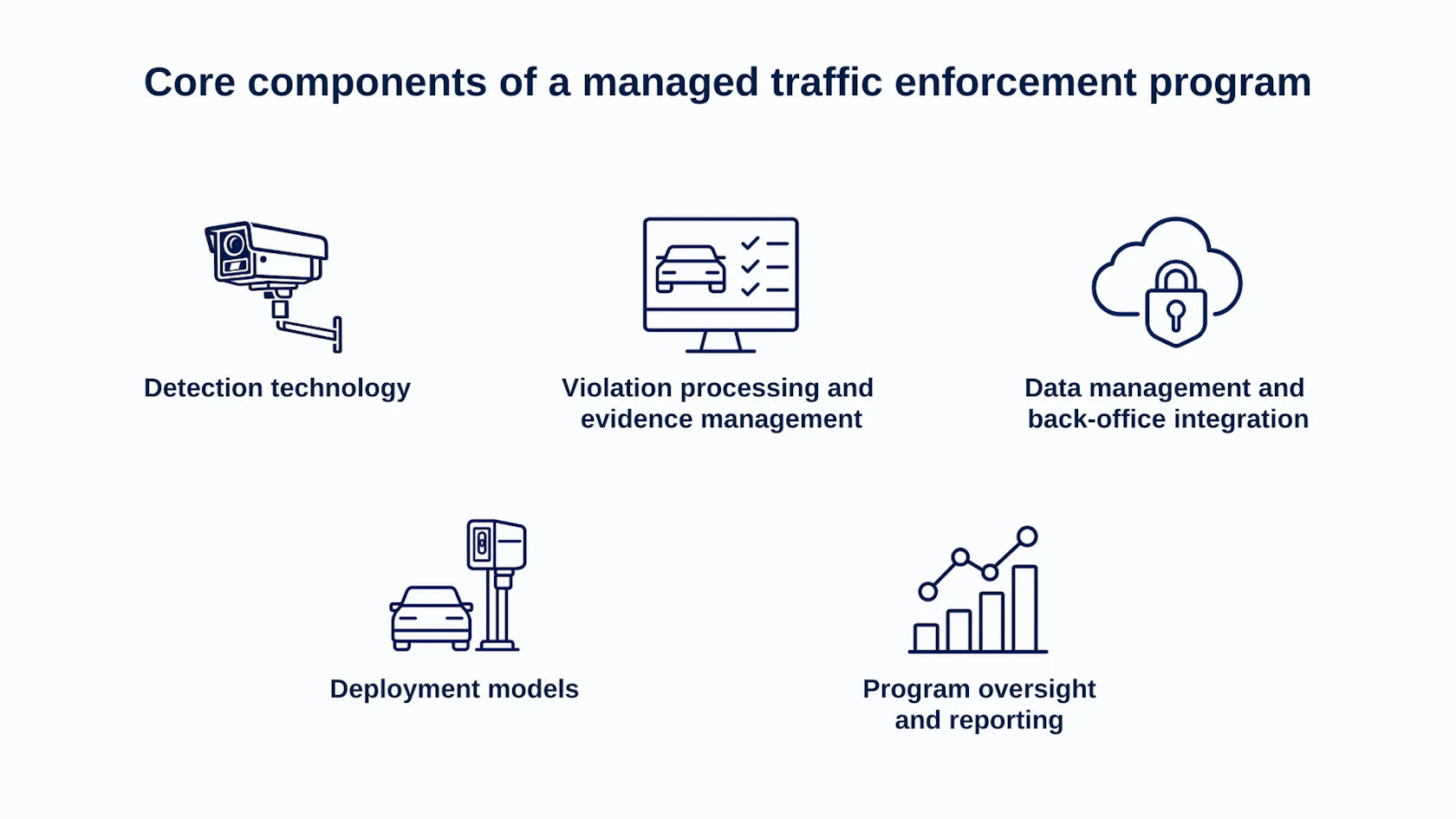
core components of a managed traffic enforcement program

How traffic enforcement technology works in practice

A traffic enforcement system is only as valuable as the evidence it produces. If any link in the chain breaks (sensor accuracy, image quality, data integrity, or operator review) the citation becomes vulnerable to legal challenge. This is why the technical process behind enforcement matters as much as the hardware itself.

Lidar versus radar – choosing the right detection method

In speed enforcement, both lidar and radar have a role to play. Lidar-based systems are known for high spatial precision and for assigning a measurement clearly to a specific vehicle, even in multilane traffic. That matters when road authorities need evidence that is transparent, traceable, and legally defensible. VITRONIC’s traffic enforcement materials therefore position lidar-based measurement wherever precise vehicle assignment and court-grade evidence are critical.

Radar, by contrast, brings other strengths to the portfolio. VITRONIC’s example material points to radar’s range and to its value as part of broader sensor strategies. At the same time, radar-based approaches can face challenges such as ghosting, which is why modern enforcement platforms increasingly rely on software, image documentation, and sensor combination to improve overall reliability. For road authorities, the key question is therefore not lidar or radar in absolute terms, but which measurement principle best fits the roadway, traffic pattern, enforcement objective, and evidentiary standard of the program.

Emerging capabilities – from AI to multi-violation detection

Modern enforcement platforms now go well beyond speed measurement. Three developments are reshaping what a single installation can do.

Multi-violation detection: One camera system can now enforce speed limits, red-light compliance, and tailgating simultaneously. This consolidation reduces hardware cost per enforcement point and increases the return on each installation.

AI-powered scene analysis: Image recognition algorithms detect vulnerable road users in the enforcement zone, flag seatbelt violations, or identify drivers using mobile phones. These capabilities turn enforcement cameras into broader road safety sensors.

Remote monitoring and autonomous operation: Fleet operators can check system health, battery levels, and camera alignment without visiting the site. Enforcement trailers operate autonomously for up to 30 days, transmitting data via encrypted cellular connections. This is what makes unattended deployment in work zones and hazardous locations viable.

Fixed, mobile, and semi-stationary – choosing the right deployment

No single deployment model fits every enforcement objective. Road authorities usually need to balance permanence, flexibility, staffing, and risk exposure.

Fixed systems are well suited to locations with persistent risk patterns and long-term enforcement needs. Mobile systems are valuable when authorities need flexibility or officer-led deployment. Semi-stationary systems create a strong middle ground: they offer autonomous operation for extended periods and are particularly useful where roadside conditions make frequent manual enforcement difficult or unsafe.

Fixed, mobile, and semi-stationary – choosing the right deployment for managed traffic enforcement

Managed versus in-house enforcement: which model scales better?

For many authorities, the core decision is not simply which technology to buy. It is whether to build and run the program internally or to work with a managed partner.

Personnel and operational constraints

In-house enforcement requires more than equipment. It requires skilled staff for monitoring, evidence handling, review, maintenance coordination, notice administration, reporting, and issue resolution. Many authorities face limits in both staffing availability and budget predictability. A managed program addresses this by shifting operational delivery to a specialist provider while preserving agency oversight.

Legal defensibility and evidence integrity

A program is only as strong as its weakest procedural link. Calibration status, chain of custody, system logs, review standards, and evidence completeness all affect legal admissibility. Managed partners are structured to maintain these controls continuously. That reduces the burden on the authority and supports more consistent case quality over time.

Scalability without repeated reinvention

When an authority wants to expand from a pilot to a broader network, a hardware-led approach can create procurement and integration friction. A managed model is more scalable because the program framework already exists. Additional sites, new deployment types, or expanded workflows can be added within an operating structure instead of recreated from scratch.

Technology refresh and lifecycle continuity

Traffic enforcement technology does not stand still. Hardware ages, software requirements evolve, and reporting expectations become more demanding. Under a managed service contract, upgrades and service continuity can be built into the model. That is often more practical than managing depreciation, replacement cycles, and fragmented vendor responsibility internally.

Selecting a partner for managed traffic enforcement is a long-term decision. The most important criteria go beyond hardware specifications.

What road authorities should evaluate when choosing a managed traffic enforcement partner

Precision and legal admissibility: Authorities should assess whether detection technology supports precise vehicle assignment, clear evidence generation, and defensible case handling.

End-to-end capability: Some suppliers provide hardware, others provide back-office services. Fewer deliver the full chain in a coordinated way. Authorities should examine whether the partner can support deployment, maintenance, evidence handling, notice workflows, reporting, and operational accountability under one model.

Jurisdictional experience: Road authorities should also assess whether the partner has experience across jurisdictions and operational environments. This matters for compliance, implementation realism, and program resilience.

Integration and security: The partner must fit into the authority’s broader ecosystem. That includes back-office integration, data security, audit trails, reporting access, and compatibility with local workflows. A traffic enforcement program touches sensitive operational and citizen data. Security and transparency therefore belong in the core evaluation.

Summary

In short

  • Effective traffic enforcement today goes beyond individual devices — it requires a fully integrated, end-to-end program.
  • Managed traffic enforcement enables road authorities to expand coverage without increasing operational complexity or staffing needs.
  • Precise detection technologies such as lidar or radar ensure reliable, legally defensible evidence in modern enforcement programs.
  • Flexible deployment models — fixed, mobile, and semi-stationary — allow authorities to address different road safety challenges effectively.
  • VITRONIC combines technology, software, and operations into scalable solutions that deliver measurable road safety outcomes.
Modern traffic enforcement is no longer defined by standalone cameras, but by how effectively the entire enforcement chain works together. From detection and evidence generation to violation processing and program management, each step must be reliable, scalable, and legally sound. Road authorities face increasing pressure to improve safety while working within limited resources. Managed traffic enforcement addresses this challenge by shifting from hardware-focused approaches to fully integrated programs that ensure operational continuity and consistent results. With more than 40 years of traffic enforcement experience and proven deployments such as Montgomery County, MD, VITRONIC supports agencies with end-to-end solutions that combine precision, flexible deployment, and comprehensive program management — enabling safer roads and more efficient enforcement.
Boris Wagner

Boris Wagner

Director Sales Traffic Technology Division
E-Mail
boris.wagner@vitronic.com
Telefon
+49 611 7152 0

フォローする

詳しく読む

Driver using a mobile phone behind the wheel – example of distracted driving
AI-Based Enforcement Stops Dangerous Behavior
Increasing number and diversity of road users are leading to complex traffic scenarios
ブログ記事

Mobility on the Move

How video-based systems help shape the traffic of the future
Subscribe to Newsletter
the machine vision people

Whether in automation or traffic engineering: With our systems our customers see more. The combination of hardware, data and intelligent evaluation makes applications and analyses possible that were unthinkable until recently. A previously hidden world becomes visible and usable.