Smart MobilityRadar vs. Lidar:
Why the Use Case Matters
Why modern enforcement systems do not rely on an either-or approach, but choose the right measurement technology for each application
Precise measurement technology as the foundation of modern traffic enforcement
Reliable traffic monitoring begins with precise measurement technology. A traffic enforcement system must not only record a measurement value but also make it reproducible, traceable, and assign it clearly to a vehicle. Only when measurement, object tracking, and case documentation work together seamlessly is a reliable process created for enforcing traffic rules.
At the same time, the requirements for modern traffic enforcement have become more varied. Mobile and stationary applications, multi-lane roads, intersections, high mounting positions, combined enforcement tasks, or integration with traffic management systems—all these bring specific technical requirements. Economic factors, installation effort, and use of existing infrastructure are also becoming increasingly important in many markets.
That’s why it’s not enough to compare measurement technologies in the abstract. What matters is which measurement principle offers the best combination of performance, assignment reliability, usability, and cost-effectiveness for the specific use case.
Lidar: High-performance measurement technology for the most demanding requirements
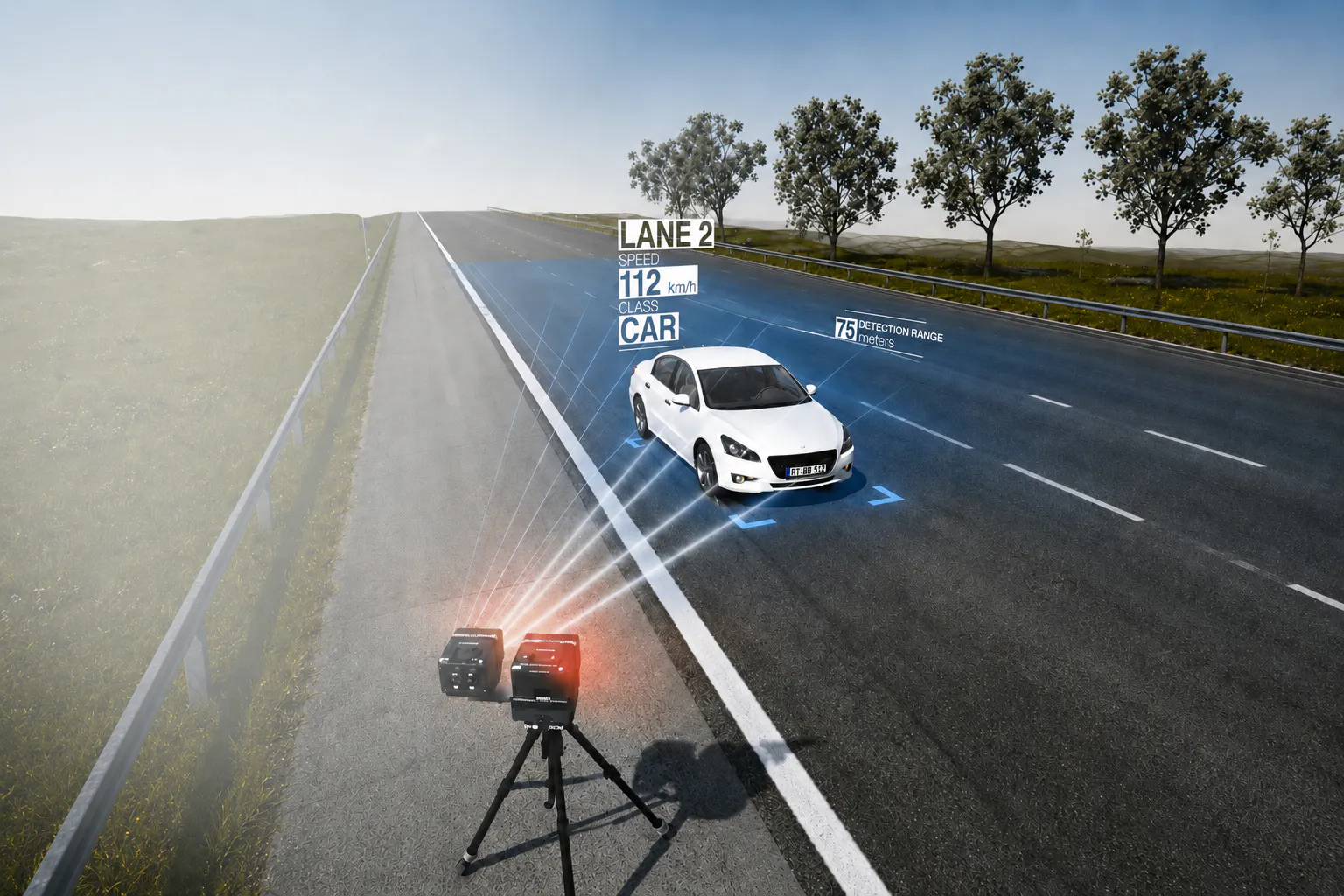
Scanning lidar technology has established itself as a high-performance solution in automated speed enforcement for good reason. This principle allows for very high spatial resolution and precise detection of object positions. Multiple vehicles can be reliably and simultaneously detected, separated from each other, and tracked across the detection field.
Lidar demonstrates its strengths particularly in multi-lane, high-traffic situations. Accurate distance measurement and object tracking help distinctly separate vehicles, record violations correctly, and document cases in a way that is easy to follow. This means lidar supports high measurement fairness—especially where complex traffic situations could otherwise lead to undetected or ambiguously assigned incidents.
Lidar’s precision may also play a key role in red light enforcement applications subject to metrological certification and calibration requirements. Here, the position of the vehicle, its relation to the stop line, and the precise time of passing the line must be accurately determined and documented. In these applications, lidar-based systems can leverage their strengths in spatial resolution, object tracking, and clear assignment.
For use cases where the highest precision, maximum performance, and guaranteed vehicle separation are critical, lidar-based systems like Poliscan FM1 are the benchmark within the VITRONIC portfolio.
Radar: A proven measurement principle with new possibilities
Radar has been used in traffic enforcement for decades. However, many technical reservations about radar stem from a time when radar systems were primarily understood as classic Doppler radars. These systems could reach their limits under certain conditions—such as with signal reflections, ambiguities in complex traffic, or when it came to clearly assigning a measured value to a particular vehicle.
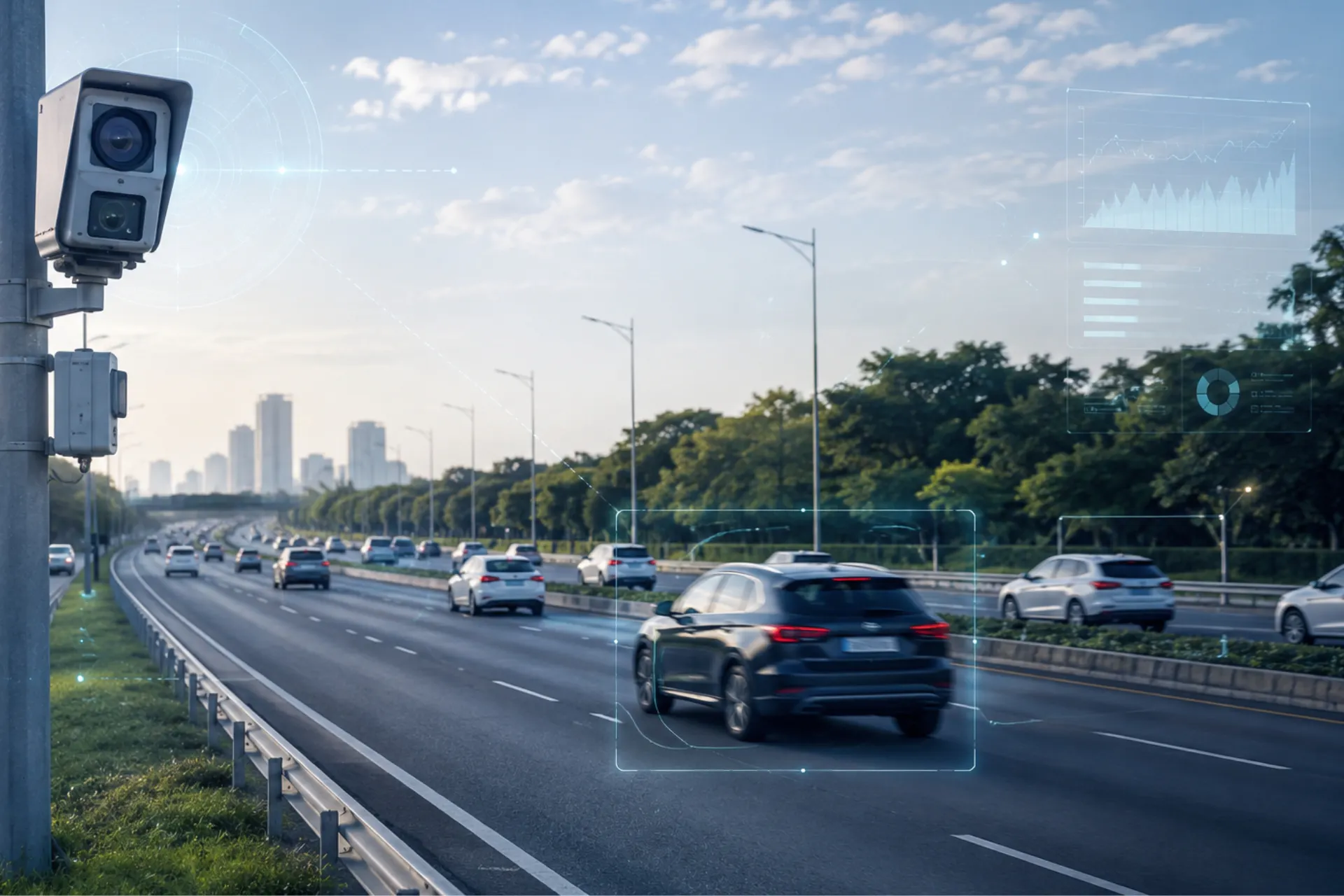
Modern 3D and tracking radar architectures go significantly further. They do not only capture speed, but also use distance, angle, and movement data. This allows objects to be tracked over time, trajectories to be validated, and measurement situations to be assessed more robustly.
Radar is therefore not a return to older technology, but a proven measurement principle with new possibilities. Especially in cases where maximum measurement performance is not the main priority but flexible installation, higher mounting positions, compact integration, and scalable rollouts are required, modern radar technology opens up new opportunities for automated traffic enforcement. This is particularly relevant when using existing infrastructure like poles or bridges.
What should a modern traffic enforcement system achieve?
Modern enforcement systems need to do more than just record sensor data. Alongside precise sensor technology, it takes a reliable combination of measurement data, video information, object tracking, and AI-powered scene analysis. Especially for radar-based measurement technology, this interplay can unlock additional strengths: Video data provides context for the traffic situation, while tracking and intelligent evaluation help better classify objects, trajectories, and potential ambiguities.
Accurate measurement remains the foundation. Supplementary data does not replace a reliable measurement value but supports the secure assignment, validation, and documentation of the measured event. For example, situations involving vehicles traveling close together can be systematically assessed and potential ambiguities detected early on.
If a measurement scenario cannot be clearly validated and assigned to a vehicle, it must be annulled based on clear criteria before being documented as a case.
This interplay is crucial, particularly for automated enforcement applications: Every incident must be technically captured, clearly assigned, and documented in a way that stands up in court. Only then will the case documentation meet the demands of modern traffic enforcement.
Summary
In short
- Radar and lidar are not opposites, but different solutions for different usage scenarios.
- Lidar is the measurement technology for applications with the highest demands on precision, performance, and vehicle separation.
- Radar expands the range for flexible installation, higher mounting positions, compact integration, and scalable rollouts.
- The combination of measurement data, video information, tracking, and AI-powered scene analysis supports the secure assignment, validation, and documentation of enforcement cases.
- It’s not just about the technology itself, but its suitability for the specific application.