Artificial intelligence opens up new possibilities in automated weld seam inspection, especially in the detection and evaluation of complex defect patterns that are difficult to describe. It complements classic, rule-based measurement technology where it reaches its limits. At the same time, clear measurement values and standard-compliant results remain indispensable. Systems such as VIRO WSI show how AI can already be integrated into existing inspection processes in a meaningful, safe, and practical way—as a supporting tool on the path to data-driven, sustainable quality assurance.
Menü
The future blog of the Machine Vision People
Smart ProductionWeld Seam Inspection
with AI
What is possible today, and where are the limits? A quantum leap, but not limitless?
Artificial intelligence in weld seam inspection is becoming increasingly important It promises greater flexibility in evaluation, higher detection rates for elusive defects, and more precise seam detection in automated processes. But what can AI really achieve today? Where are its limits?
How AI opens up new perspectives in industrial quality inspection
Previous inspection methods work with fixed rules: a feature is detected or measured, compared with limit values, and automatically evaluated. This works well for geometrically clear deviations. Rule-based systems fail due to a lack of selectivity: a spatter cannot always be clearly distinguished from the seam surface on a complex weld seam surface by a measuring algorithm based on gray values. For example, shading can be interpreted as a hole using conventional methods. The result: high pseudo-error rates, too much manual rework, and increasing inspection costs. In this situation, AI opens up new scope and possibilities. However, its use must be understood holistically – technically, organizationally, and legally.
Artificial intelligence offers advantages in weld seam inspection precisely where classic systems reach their structural limits: in the detection and classification of complex irregularities that do not follow a linear rule, as well as defects, in the localization of complex seam courses, and in the reliable differentiation between relevant deviations within permissible variance.
Automatic seam detection with AI
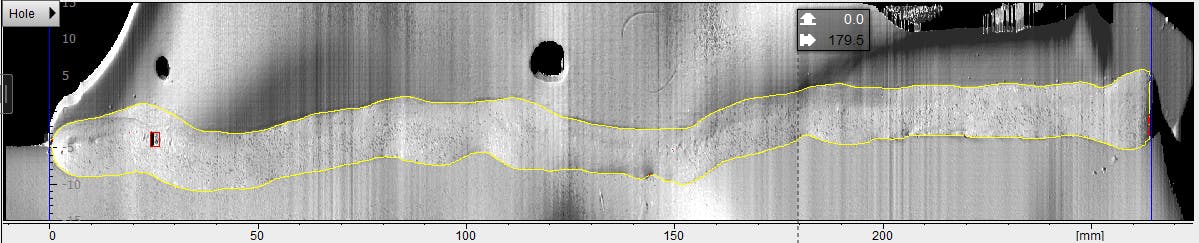
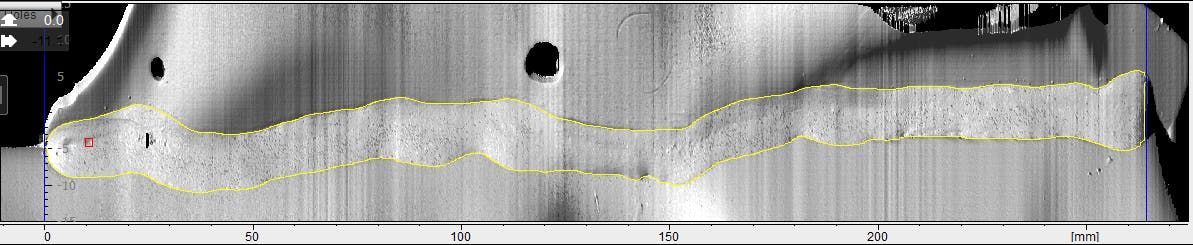
A key area of application is automatic seam detection. In practice, this means that AI uses geometric and gray-value-based features to recognize where a seam begins, how it runs, and where the inspection area ends. This ability is crucial for setting the focus of the inspection correctly – regardless of component position, surface condition, or process variation.
Reducing costly errors with AI
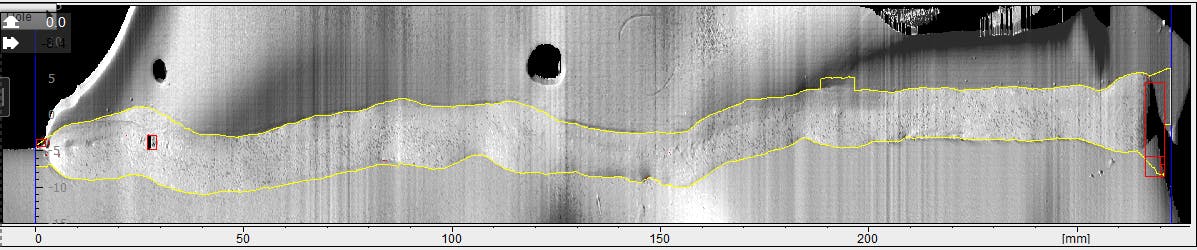
Another advantage is the reduction of costly pseudo-errors. AI improves selectivity—that is, the ability to reliably detect genuine errors while ignoring non-critical features. This reduces the rework rate and increases inspection reliability.
AI does not replace measurement technology – but it reliably detects what classic systems overlook. Especially in the case of complex irregularities, seam patterns, and varying geometries, it delivers stable results where rule-based approaches reach their limits.”
Why AI will not become the sole solution in measurement technology
Despite its advanced capabilities, AI cannot replace traditional measurement technology in industrial quality inspection. The difference lies in the principle: while conventional systems generate discrete, clearly measurable values—such as seam widths in millimeters or the depth of a recess in defined tolerance levels—AI works on the basis of probabilities. It does not say, “This seam is exactly 20.2 mm wide.” It says, “It is highly probable that a seam structure lies within the known pattern.”
However, this is not sufficient in many standardized inspection processes. Discrete results are required when components are accepted, documented, or audited according to industrial standards. In these cases, the probability of a deviation is not sufficient—the measurement must be unambiguous, traceable, and reliable.
This is not only a technical issue, but also a regulatory one. Standards such as DIN standards or factory-specific standards of automobile manufacturers define test characteristics, test tolerances, and limit values precisely. Systems that do not provide verifiable individual values are currently not recognized as sole testing equipment.
Today, AI is not allowed to decide autonomously whether a component is acceptable or not. Its role is to assist—it helps to narrow down test areas, identify fault characteristics, and highlight critical points.
This distinction is also relevant in terms of product liability. The final decision rests with the higher-level testing system or the responsible personnel. This clarifies the legal framework within which AI systems can currently be used – and where their limits lie. One thing is clear: AI expands the testing strategy. But it does not replace existing testing obligations – neither technically nor legally.
How VITRONIC is integrating the possibilities of AI into VIRO WSI today
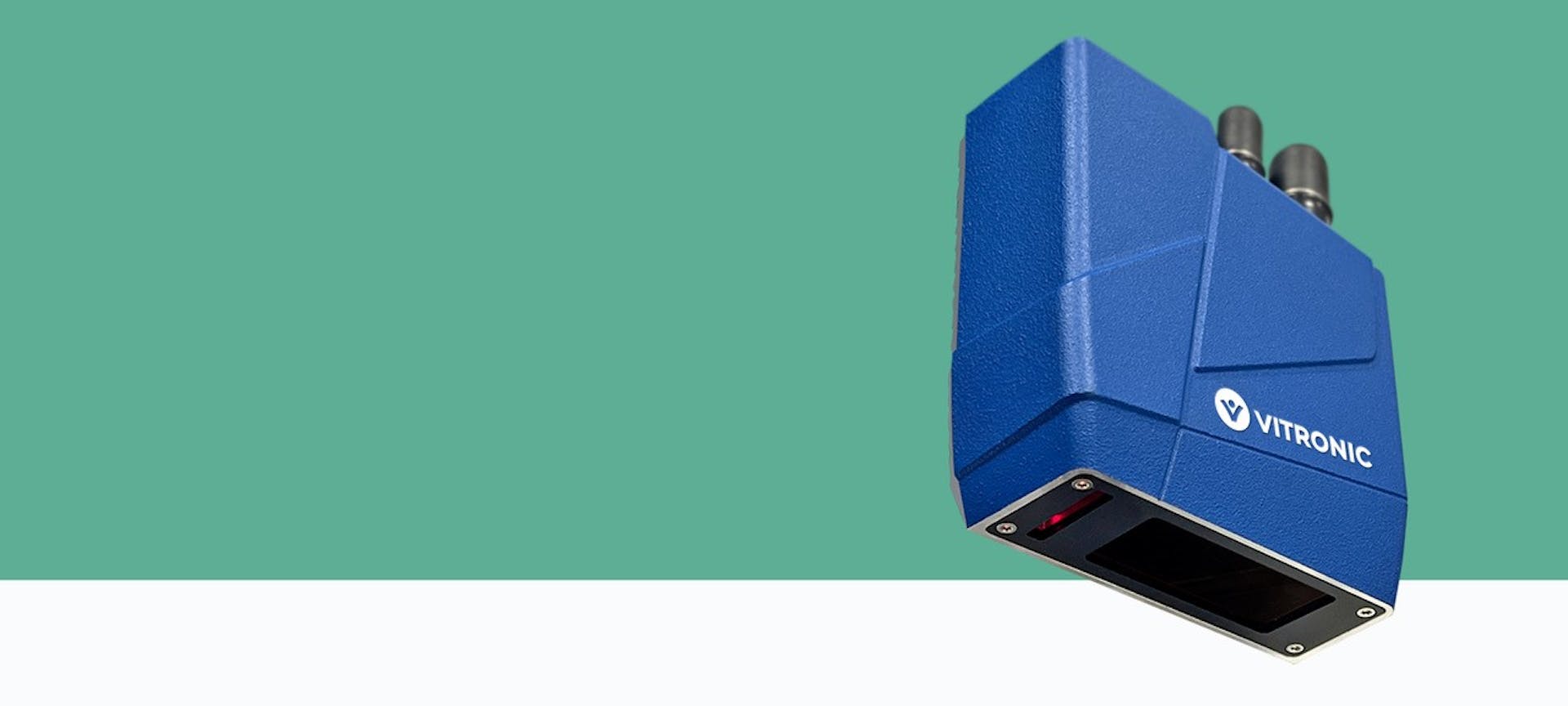
The VIRO WSI system from VITRONIC shows how AI can already be used in series production today—without regulatory conflicts and with clear benefits for quality assurance. It combines laser-based 3D sensor technology with AI-supported image evaluation and was developed specifically for the inline inspection of weld seams in car body manufacturing. The focus is on two tasks: automatic seam detection and the classification of complex irregularities.
Seam detection is based on geometric features. The system recognizes where a weld seam begins, where it runs, and where it ends – even with varying components, changing positions, or altered surfaces. This eliminates the need for manual definition of inspection areas and makes localization more robust against manufacturing fluctuations.
VIRO WSI uses a combination of gray value and height information for error detection. Unlike many commercially available systems, it not only analyzes the two-dimensional image, but also takes into account the depth structure of the surface. This improves classification: holes and pores can be reliably distinguished from spatter, splashes are recognized as separate features, and seam depressions can be evaluated. Depending on the welding process and the sensor used, defect sizes from 0.1 mm are detected. The evaluation takes place in real time directly on the line. The effects are particularly evident where a clean seam assessment is necessary—for example, to reduce downstream grinding, cleaning, or correction processes.
The AI does not work autonomously. It is embedded in a classic inspection system and delivers validated, traceable results. All detections are documented, and borderline cases can be verified manually. VIRO WSI thus meets the requirements for solutions within the framework of existing factory specifications and standards. VITRONIC deliberately avoids the use of specialized high-performance computers. The system runs on standard industrial hardware and can be integrated into existing lines without any infrastructural hurdles.
Where is measurement technology with AI headed in the near future?
Currently, probabilistic systems are not covered by many standards or are subject to strict capability analyses. Most industrial testing standards require clearly measurable, discrete results—precisely what AI cannot currently deliver. That is why AI will remain an assistance system in the medium term. However, pressure for further development at the legislative and standardization level is growing. More and more companies are relying on data-driven, digital processes – in production as well as in quality assurance. With these increasing amounts of data, systems are needed that can perform reliable analyses.
AI is changing the quality inspection of weld seams – not radically, but structurally. Systems such as VIRO WSI show how intelligent image processing can be combined with existing inspection processes without violating standards or incurring liability risks. The use of AI does not lead to full automation, but to targeted support – where classic systems are too rigid, too error-prone, or too inflexible.
Conclusion
In Short:
- AI enhances weld seam inspection by detecting complex defect patterns, seam profiles, and irregularities that are difficult to detect using traditional methods.
- Measurement technology remains indispensable: standards, auditability, and product liability continue to require clear, discrete measurement values.
- VIRO WSI combines both by combining AI-supported image evaluation with laser-based 3D measurement technology – for less scrap, greater process reliability, and a sustainable quality strategy.