Speed enforcement is no longer only a hardware decision. Road authorities need to decide whether they want to own, operate and maintain systems internally, or whether a specialist partner should manage the full enforcement chain. Both models are valid. Capital purchase can deliver long-term value for authorities with established technical teams, stable capital funding and a clear preference for asset ownership. Speed enforcement as a service is often the stronger option for agencies that need faster deployment, predictable OpEx, contractual service levels and the flexibility to expand across sites and violation types.
VITRONIC supports both hardware purchase and end-to-end managed traffic safety enforcement. Its managed traffic enforcement experience, including the Montgomery County, Maryland program, shows how a TSaaS approach can combine proven enforcement technology with operational accountability.

Smart MobilitySpeed Enforcement as a Service vs. Capital Purchase
How road authorities can compare owned hardware, managed enforcement programs, cost structure, operational control and long-term flexibility.
Road authorities are under growing pressure to expand speed enforcement coverage. At the same time, capital budgets are being scrutinized, staffing is tight, and enforcement programs are becoming more complex. The decision is no longer only about which automated traffic enforcement system to buy. It is also about how to structure and fund the program.
Most decision makers face two practical options: a capital purchase model, where the authority buys the hardware and operates the program largely in-house, or speed enforcement as a service model, where a specialist partner delivers the full program under contract. This guide compares both approaches across cost, deployment, maintenance, compliance and scalability.
Two models, one goal: safer roads
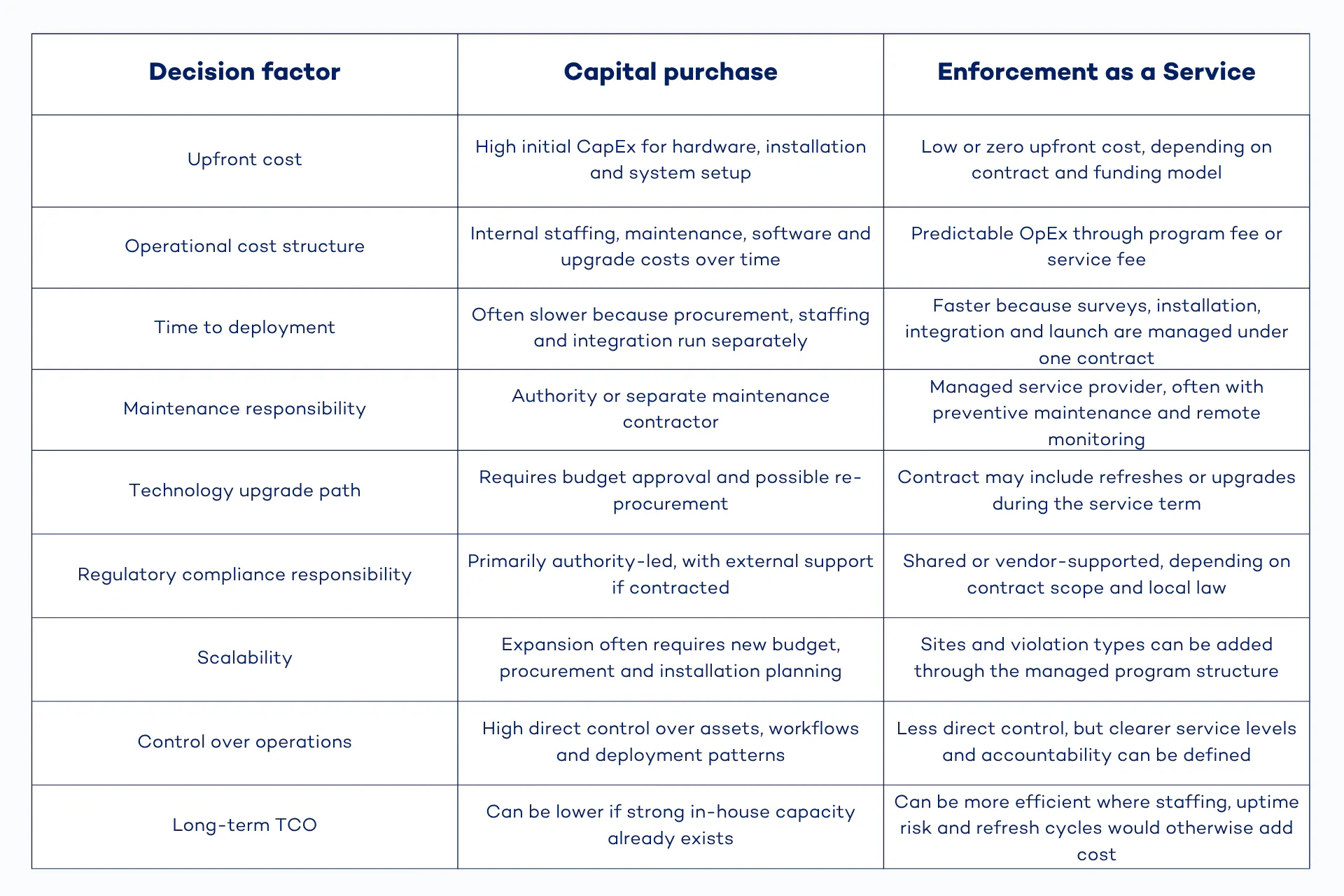
In a capital purchase model, the road authority funds the procurement of enforcement hardware, owns the assets, and remains responsible for operating the program. The authority may handle installation, maintenance, calibration, violation processing and software integration internally, or contract some of those tasks separately. This model gives the agency a high degree of control, but it also requires budget, technical capacity and long-term operational commitment.
In enforcement as a service model (or called Traffic Safety as a Service), the authority contracts a vendor to deliver the program as a managed service. The provider typically supplies the hardware, software, integration, maintenance, monitoring, calibration support, violation processing and compliance workflows under one agreement. Instead of a large capital expenditure, or CapEx, the authority pays through operational expenditure, or OpEx, such as a recurring program fee or transaction-fee structure, depending on procurement rules and local law. Commercial structures vary by jurisdiction and must align with local legal requirements.
The choice is not always binary. Some authorities own certain assets but outsource the managed layer. Others start with a turnkey enforcement program and later expand into hybrid procurement. The right model depends on internal capacity, funding rules, deployment timeline and risk allocation.
The case for capital purchase: when owning makes sense
Capital purchase is a strong option for authorities that already have experienced enforcement teams, technical staff and established back-office processes. If an agency can operate, maintain and update its own systems reliably, ownership can provide long-term value.
The strongest argument for capital purchase is control. In-house teams can decide how assets are configured, where they are deployed, how workflows are integrated and when operational changes are made. This can be important for large highway authorities, national road agencies, or jurisdictions where procurement law requires government ownership of enforcement equipment.
Capital purchase can also offer a lower total cost of ownership over a 10- to 15-year horizon, but only if the authority already has the staff, processes and infrastructure required to run the program. Specific cost drivers include staffing levels, calibration capacity, software licensing, maintenance contracts and the cost of hardware refresh cycles. Without those foundations in place, the savings may not materialize.
The constraints are real. Upfront CapEx can be significant across a network. Technical recruitment and retention can be difficult. Hardware refreshes may require new procurement cycles. Evidence quality, uptime, calibration records and legal defensibility all remain the authority’s responsibility unless separate service agreements are in place.
The case for enforcement as a service: when the managed model wins
Speed enforcement as a service is often the stronger model when authorities need fast deployment, predictable costs and a single accountable partner. The vendor can handle site surveys, installation, commissioning, software integration, maintenance, monitoring, calibration support and processing workflows, while the authority retains policy control and final statutory decisions. This can shorten the path from approval to operation, especially for authorities launching a new program.
The managed traffic enforcement model also shifts the funding discussion. Instead of asking for a large capital budget to buy equipment, agencies can structure the program as OpEx. Traffic Safety as a Service (TSaaS) models can reduce or remove upfront cost, and commercial structures may be adapted to the authority's procurement rules and legal framework.
Operational risk is another major factor. Modern automated traffic enforcement is not just a roadside device. It is a chain of measurement, imaging, data transfer, review, owner lookup, violation package creation, approval, printing and mailing. In a managed model, the provider can be responsible for uptime, service monitoring, preventive maintenance, calibration support, evidence quality and compliance processes. That accountability needs to be written into the contract.
Scalability is also easier. Authorities can add sites, expand coverage, or introduce adjacent violation types such as red-light enforcement or bus lane enforcement without treating every expansion as a separate hardware ownership project. Managed contracts may also include technological refreshes, making it easier to adopt improved hardware, software and AI-supported capabilities during the contract term.
A framework for making the decision
Before choosing a model, road authorities should answer a practical set of questions:
Questions
- Do we have qualified technical staff to operate, maintain and troubleshoot an automated traffic enforcement system?
- Is capital budget available and likely to be approved, or is operational funding more achievable?
- Do we need to deploy in weeks or months, or can the program wait for a longer procurement cycle?
- Are we expanding an existing enforcement fleet, or starting from a new program baseline?
- Do we need multi-violation capability, such as speed enforcement, red-light enforcement and bus lane enforcement?
- Can our internal team manage calibration records, evidence quality, documented evidence handling from capture through review and final disposition and court defensibility?
- Do we need contractual guarantees and defined service-level expectations for up-time, response times and evidence quality standards?
- How important is flexibility to add new sites without re-buying hardware?
If the answer is “yes” to strong in-house capacity, long-term ownership and available CapEx, capital purchase deserves serious consideration. If the answers are “limited staff,” “OpEx preferred,” “quick deployment” and “multi-violation expansion,” the managed service model is usually the better starting point.
What to look for in a managed enforcement partner
A managed enforcement partner should be evaluated on more than equipment supply.
Technology precision. Measurement methods, camera performance, calibration process and vehicle assignment all influence whether evidence can stand up to review. Where lidar-based systems are used, agencies should understand how technology supports clear vehicle attribution and produces evidence packages designed to support review, auditability and legal defensibility, subject to local requirements.
End-to-end capability. A true traffic enforcement solution should cover hardware, software, integration, maintenance, monitoring, violation processing, Automatic License Plate Recognition (ALPR) accuracy, data security and chain-of-custody management. Hardware-only suppliers may still be valuable, but they do not remove the operational burden from the authority.
Service levels. Authorities should ask how uptime is measured, how fast repairs are made, what evidence quality standards apply, how calibration is documented and what happens when a site is offline. A managed model only works if defined service-level expectations for up-time, response times and evidence quality are written into the contract.
What a managed program can look like in practice
Example: VITRONIC managed enforcement program
VITRONIC's evolution from hardware manufacturer to end-to-end service provider reflects a broader shift in how road authorities are structuring enforcement programs. The Montgomery County, Maryland program, announced in 2025, illustrates what a mature TSaaS model can deliver in practice:
- A single accountable vendor managing the full operational chain
- Proactive service monitoring with defined response expectations
- Calibration support integrated into the service, not handled separately
- Centralized violation processing covering event ingestion, review, owner lookup and package creation
- One platform that can scale across sites and violation types
- Technology that can be refreshed within the contract term
For authorities evaluating long-term partners, a managed program like this provides one point of accountability and a contractual basis for measuring it. A mature TSaaS model gives them one accountable vendor, contractual uptime and quality expectations, and a software-first platform that can scale across sites and violation types.
FAQ
What does enforcement as a service include?
Enforcement as a service typically includes hardware, software, installation, integration, maintenance, monitoring, calibration support, violation processing and compliance workflows under one contract. The authority retains policy control and final approval responsibilities, while the service provider manages the technical and operational chain required to keep the program running.
What are the upfront costs of a capital enforcement program?
A capital enforcement program usually requires upfront budget for roadside hardware, cameras, housing, installation, software, networking, integration and commissioning. Additional costs may include staff training, calibration equipment, maintenance contracts and back-office systems. Across a wider network, the initial CapEx requirement can become a major approval hurdle.
How long does it take to deploy a managed speed enforcement program?
A managed speed enforcement program can often deploy faster than a capital purchase because the vendor coordinates surveys, installation, integration, commissioning and service readiness. The exact timeline depends on site permitting, legal approvals and data workflows, but the model is designed to avoid separate procurement cycles for every operational component.
Who handles legal compliance in a managed enforcement service?
Legal compliance is usually a shared responsibility. The authority remains accountable for local policy, ordinance requirements and final enforcement decisions. The managed service provider supports compliance through calibrated equipment, secure data handling, defensible evidence packages, documented workflows, system monitoring and audit-ready records defined in the service agreement.
Can a road authority switch from capital purchase to a managed model?
Yes, many authorities can move from capital purchase to a managed model, but the transition should be planned carefully. Existing hardware, software contracts, data formats, maintenance obligations and legal workflows must be reviewed. Some agencies adopt a hybrid model first, keeping assets while outsourcing operations or violation processing.
Summary
In Short
- Capital purchase works best when authorities have strong technical and operational capacity.
- Speed enforcement as a service reduces upfront costs and shifts the program toward predictable OpEx.
- Managed models can accelerate deployment and simplify maintenance, calibration and compliance workflows.
- The best decision depends on staffing, budget structure, deployment timeline and scalability needs.
- VITRONIC supports both hardware purchase and end-to-end managed traffic safety enforcement.