VDA 5.3 is more than just a guideline - it is a trailblazer for the next generation of quality assurance. For weld seam testing, this means that manufacturers must rely on highly developed, automated systems to ensure sustainable, precise and standard-compliant production. Test equipment monitoring is particularly emphasized, especially in the area of weld seam inspection, where regular calibrations and automated monitoring systems make a decisive contribution to long-term measurement accuracy. By continuously monitoring and adapting test methods, the guideline supports compliance with IATF 16949 and improves quality assurance. This not only helps to optimize product quality, but also to increase customer satisfaction.
Menü
The future blog of the Machine Vision People
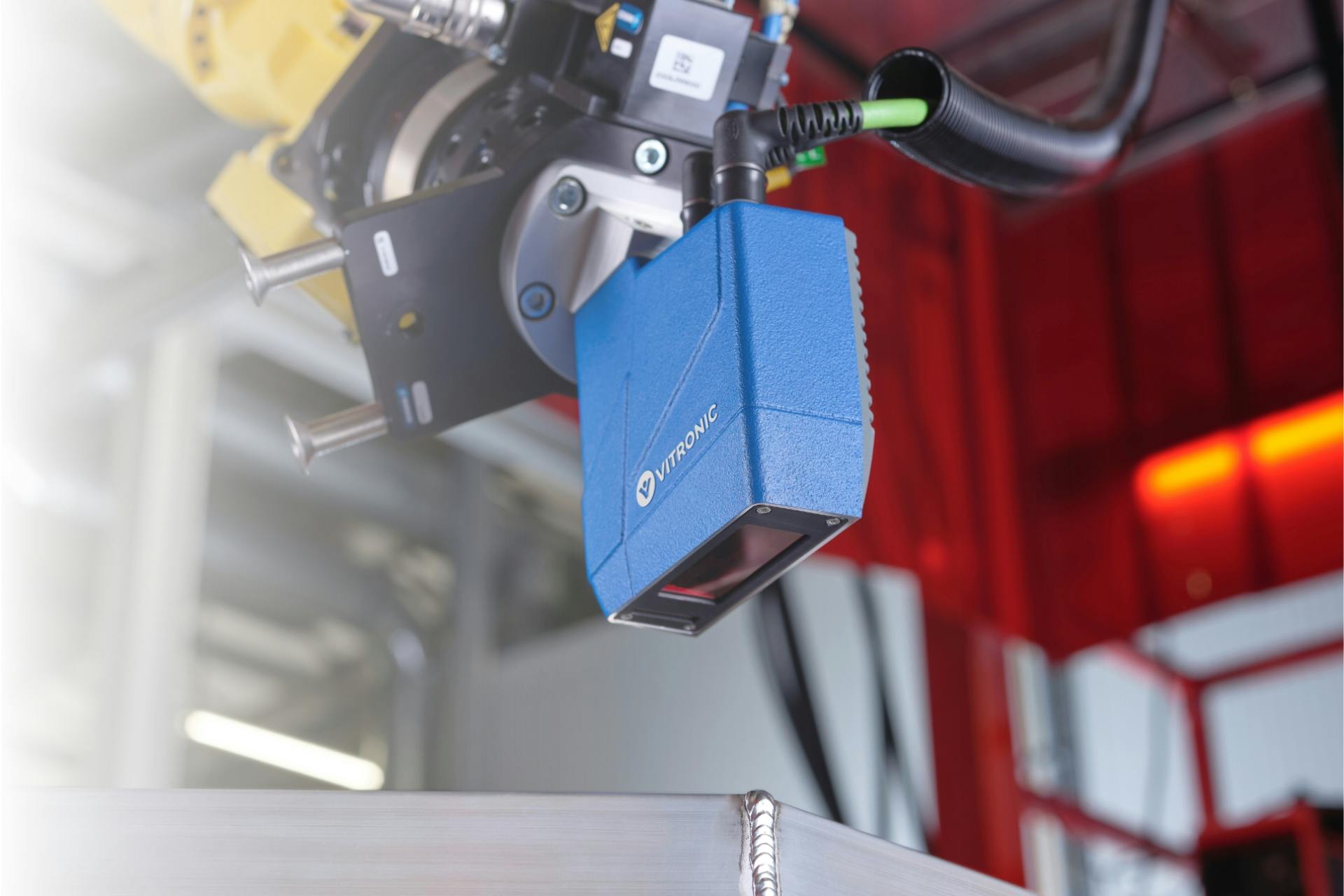
Smart ProductionVDA 5.3: Precise requirements for optical sensors
Why this guideline is so important for weld seam inspection
Quality assurance in the automotive industry requires continuous adaptation to technological advances. The VDA 5.3 volume addresses key aspects of the use of optical sensors: How do we ensure that inspection methods are accurate, reliable and future-proof?
This article provides a technical overview of:
- Key changes in the VDA 5.3 volume
- Technical requirements for optical sensors
- Practical implementation strategies
VDA 5.3, the latest revision of the central guideline for measurement and testing processes in the automotive industry, sets new standards for quality assurance. The guideline plays a decisive role for weld seam testing in particular, as it formulates clear requirements for the suitability and continuous monitoring of testing processes. Automated testing processes benefit directly from these standards, as they enable more precise and efficient methods to ensure quality and reduce costs.
Weld seam inspection is a key factor for the safety and durability of components such as battery housings and axles. VDA 5.3 recommends not only the verification of the suitability of measuring equipment, but also the consideration of environmental conditions and interferences such as lighting conditions or soiling. This underlines the importance of modern optical sensor technology, which is able to automatically inspect weld seams, detect the smallest deviations and reliably detect contamination such as weld spatter.
In addition, VDA 5.3 provides a basis for a zero-defect strategy, which is essential in an industry that relies on maximum safety and efficiency.
The recommendation helps manufacturers not only to set up inspection processes, but also to continuously optimize them in order to meet the increasing demands on quality and sustainability. Automated solutions not only meet the standard requirements, but also offer a real competitive advantage thanks to their scalability and precision.
The new VDA 5.3 makes it clear: inspection processes, especially in weld seam inspection, can no longer rely on manual procedures or inadequate systems. Advanced, optical inspection methods are the key to meeting the requirements of the standard and at the same time making production processes fit for the future.
Summary of the most important aspects for the user
Proof of suitability:
VDA 5.3 emphasizes the need to prove the suitability of measurement and inspection processes. This includes both attributive inspections and those based on machine learning. Users must ensure that the systems used meet the specified requirements and are continuously monitored in the process.
Inspection process management:
A clearly defined testing process is crucial. Users should define roles and responsibilities in inspection process management to increase efficiency. The planning and execution of inspections should be systematic in order to identify sources of error at an early stage.
Influencing factors:
VDA 5.3 also addresses the factors influencing optical sensors, such as lighting conditions and environmental conditions, which can affect measurement accuracy. Users should be aware of these factors and take appropriate measures to minimize interference.
Rules and guidelines:
The application of the VDA recommendations is voluntary. However, it is recommended to use them as best practice guidelines. Users are responsible for the correct application of the methods and must ensure that all relevant standards and guidelines are complied with.
Ongoing suitability:
It is important to ensure the ongoing suitability of testing processes. This can be done through regular reviews and adjustments to the test methods. Users should also react to unsuitable systems and make adjustments if necessary.
VDA 5.3 provides a comprehensive basis for quality assurance in the automotive industry. By observing these aspects and rules, users can ensure that their measurement and testing processes are effective and reliable. Implementing these standards not only helps to improve product quality, but also to increase customer satisfaction.

VDA 5.3 is another important step towards digitalization, standardization and problem solving in the automotive factory of the future.”
How can it be ensured that test methods according to VDA 5.3 are precise, reliable and future-proof?
Especially around the growth topic of machine learning and AI, it has been recognized in the development of VDA 5.3 that proof of capability of systems is important in order to continue to guarantee high quality in the long term. AI-based optical systems function primarily according to probabilities and correlations. Fixed properties play a subordinate role. However, it is possible to correctly “estimate” an inspection feature. Particularly in the area of surface inspection, a small error deviation is necessary to minimize any false positive or false negative statements so that the correct inspection value can be output automatically at the right time.
Whether cell surfaces in industry or weld seam appearances - the system must not only be able to detect the defect itself, but it must also be possible to demonstrate the repeatability with which it continues to perform successfully in the event of a deviation from training. These high standards have been firmly anchored in our development philosophy for years.
The VIRO WSI automated weld seam inspection system meets the requirements of the VDA standard for sensor technology With high-precision optical sensors and state-of-the-art image processing technology, the system ensures reliable and continuous inspection of weld seams. Thanks to automated monitoring mechanisms, deviations can be identified at an early stage and the inspection processes can be adapted to new requirements. The use of machine learning also enables continuous optimization of the inspection methods, which makes the system not only powerful but also future-proof.
The VIRO WSI system therefore offers a comprehensive solution for implementing the VDA 5.3 requirements using calibrated bodies and measurement system analysis (MSA) as measuring equipment and makes a decisive contribution to quality assurance.
Conclusion
In brief:
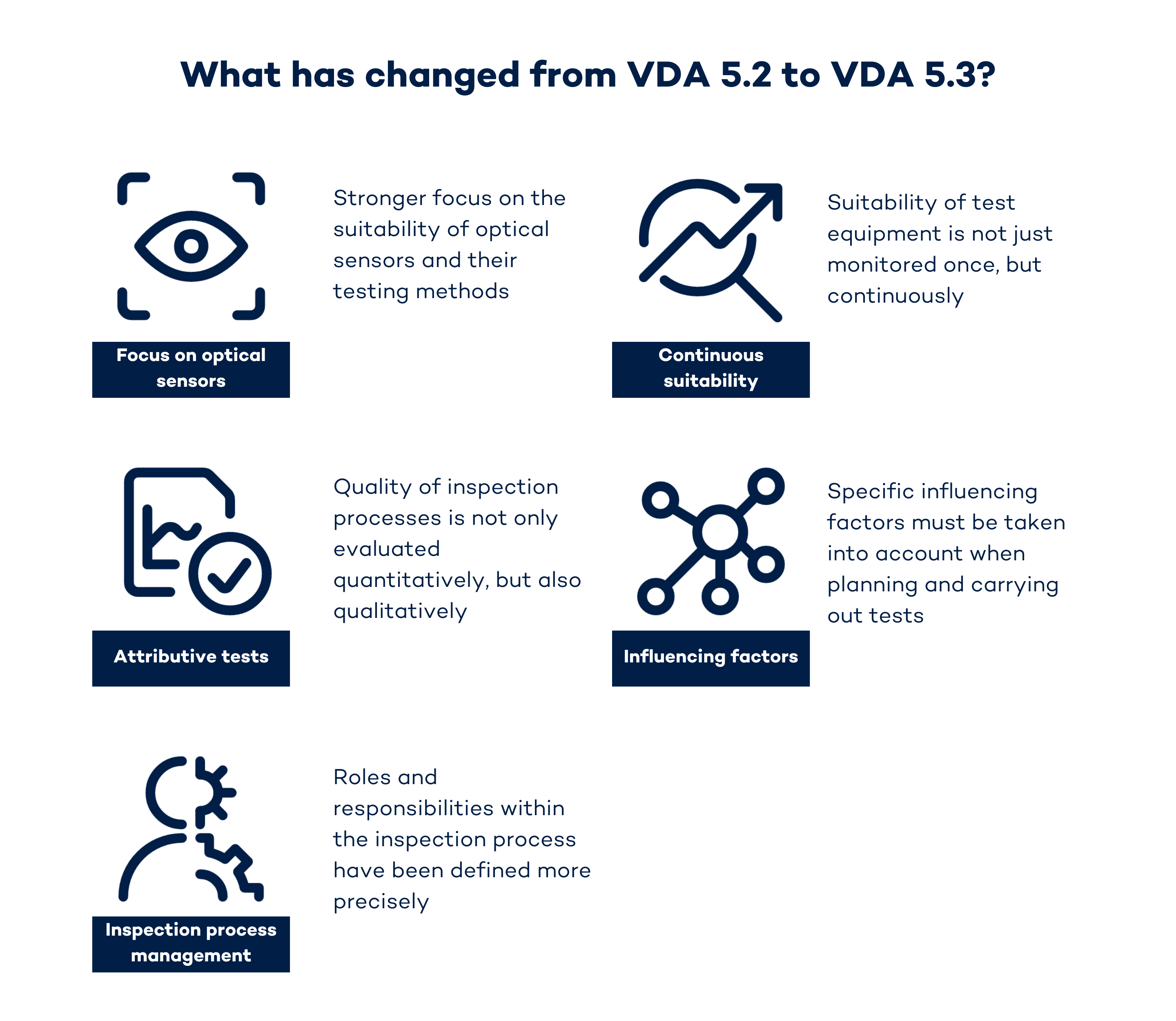
- Focus on optical sensors: VDA 5.3 places particular emphasis on the suitability of optical sensors and their test methods, a significant expansion compared to VDA 5.2, which primarily dealt with traditional measurement methods.
- Inspection process management: The new version specifies the requirements for the planning and execution of inspections and emphasizes the continuous monitoring and adaptation of critical inspection processes.
- Consider influencing factors: Lighting conditions and environmental conditions that affect measurement accuracy are explicitly addressed to help users optimize their inspection processes.