AutomotiveAutomated weld seam inspection for battery boxes of electric cars
VITRONIC is expanding the range of applications for VIRO WSI: the auto-matic inspection system can also be used to reliably inspect weld seams on battery boxes for electric cars. The boxes in the vehicle underbody are safety-critical components that make a decisive contribution to vehicle stability and fire protection. In individual cases, more than 150 individual weld seams must be perfect. However, this cannot practically be checked manually. VIRO WSI takes on this task: with a laser triangulation sensor and 3D image processing, the system permanently finds even the smallest defects in-line.
Battery boxes are critical for e-car safety
'Electric car burns out completely.' Headlines like this keep bringing up the safety aspect of e-cars. Yet statistically speaking, electric cars are extremely safe. They pose no greater fire risk than conventionally powered cars.
A major contribution to this is made by the battery boxes, which are installed in the vehicle underbody. They completely enclose the battery and are hermetically sealed. In the event of an accident, they protect the lithium-ion battery from damage and thus from short circuits that could trigger a fire. If the battery burns, it produces temperatures of over 1,000 degrees Celsius; only the fire brigade can then help. If the battery box remains intact during a collision, it can prevent ignition - or at least prevent the fire from spreading to the entire vehicle. In addition, the battery box is an integral part of the vehicle body and contributes to its stability.
Over 150 weld seams must be inspected
Manufacturers must therefore guarantee the stability of battery boxes. In addition to the materials used, the often over 150 weld seams that hold the component together are the primary contributors. They must be free of defects. In many plants, quality control is still performed by human inspectors. However, due to the sheer volume of welds and the design of the battery boxes, this is impossible. In addition, different welding methods are used for the boxes, which further complicates the inspection.
3D-sensor inspects all weld seams automatically
The VIRO WSI inspection unit solves this challenge: A robot with a 3D- sensor travels along all weld seams. The sensor measures the 3D surface geometry and thus creates 3D images of the seams. Image processing automatically detects deviations and welding defects and visualizes them for rework.
Automated weld inspection enables manufacturers to meet the requirement that battery boxes must be 100 percent visually inspected and safe. At the same time, they keep costs under control: the inspection is efficient, saves on personnel costs and can be seamlessly integrated into production processes.
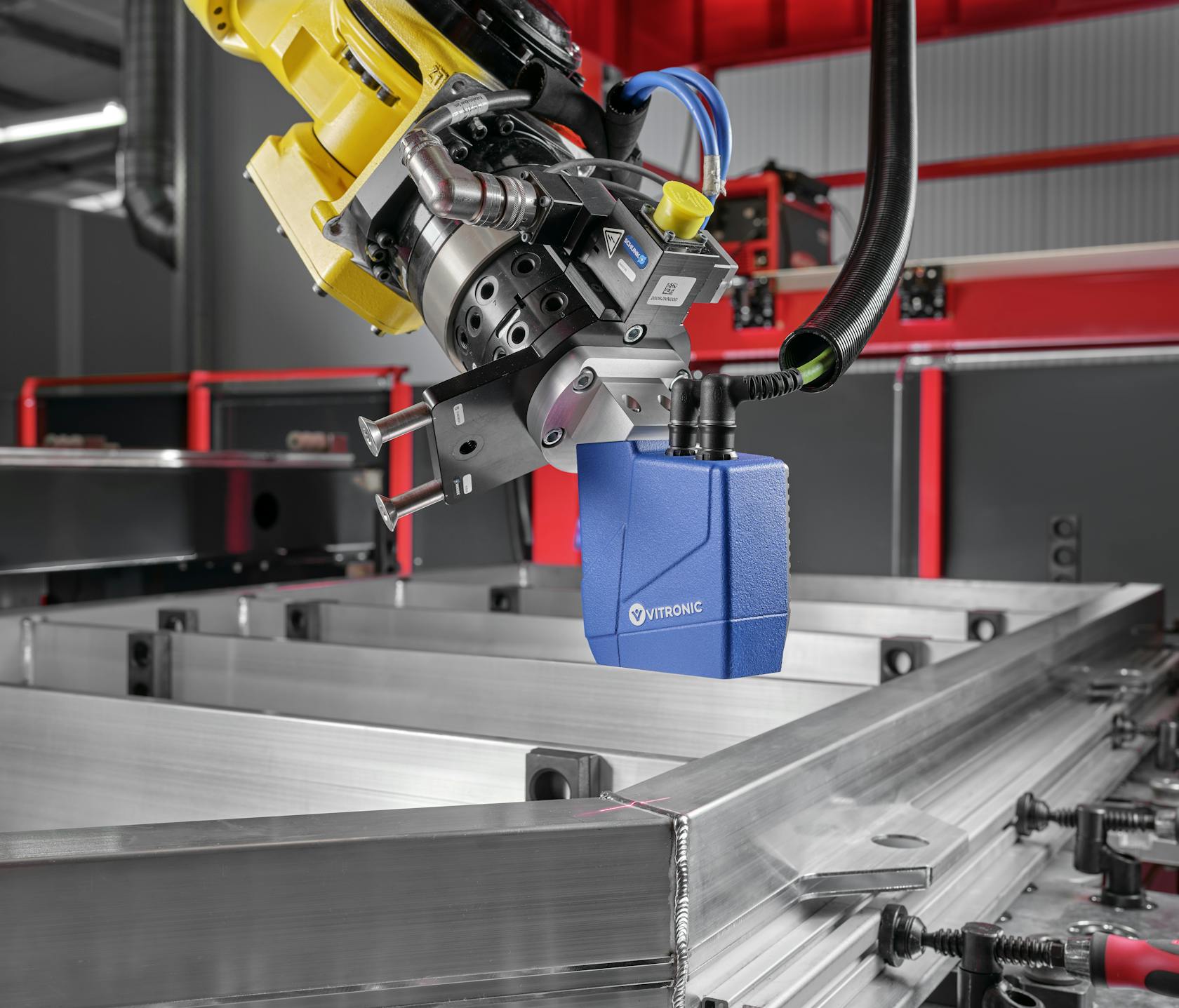
In-line inspection of VIRO WSI welds
About VITRONIC
VITRONIC is the world's leading innovation driver for machine vision, enabling its customers to master the challenges of tomorrow.
The global group of companies develops forward-looking solutions in the form of specialized products and software for image-based quality inspection, identification and process optimization, which find application in the growth sectors of automation and traffic engineering.
VITRONIC solutions make an important contribution to helping shape a safe and sustainable world. The existing limits of what is economically feasible are constantly being questioned in order to achieve the highest quality and productivity, for example in the production of automotive and pharmaceutical companies. Worldwide, Auto-ID solutions in logistics centers and at cargo airports, take over the reliable and efficient recording of shipments and thus ensure a transparent flow of goods.
In the transport sector, VITRONIC offers leading technology for increased safety on the roads, for optimizing traffic flow and for recording road usage.
Open and honest dealings with our customers form the foundation for jointly exploiting technological and process potential to the full. Joint success forms the basis of long-term cooperation with companies such as B. Braun, BMW, Daimler, DHL, UPS, Fresenius and Sanofi as well as with public clients.
Since its foundation in 1984, VITRONIC has been growing continuously for 40 years. The current annual turnover (2025) is 231 million EUR and the company is currently represented on five continents in over 80 countries with approximately 1,400 employees. Since 2024 the company is part of ITIS Holding, leveraging the strengths of both entities, creating a strong end-to-end ITS and automation provider.
Development and production of VITRONIC systems are located at the company headquarters in Wiesbaden. VITRONIC subsidiaries span across all continents, including North and South America, Europe, Asia, Africa, and Oceania. Additionally, a global network of sales and service partners ensures localized support for international customers.