Traffic TechnologyVITRONIC and DLR demonstrate managed automated driving on public roads
Successful completion of the MAD Urban research project
At a glance:
- Managed Automated Driving successfully demonstrated in real city traffic for the first time
- VITRONIC sensor technology enables precise environment detection and safe vehicle control via the infrastructure
- Milestone for the next level of automated, connected mobility
The successful completion of the MAD Urban research project, funded by the German Federal Ministry for Economic Affairs and Climate Protection (BMWK), marks an important step toward safe, connected transportation in cities. Together with the German Aerospace Center (DLR), the FZI Research Center for Information Technology, Balluff, GFT Technologies, and Intel, VITRONIC has demonstrated that managed automated driving—the interaction between vehicles and intelligent infrastructure—works.
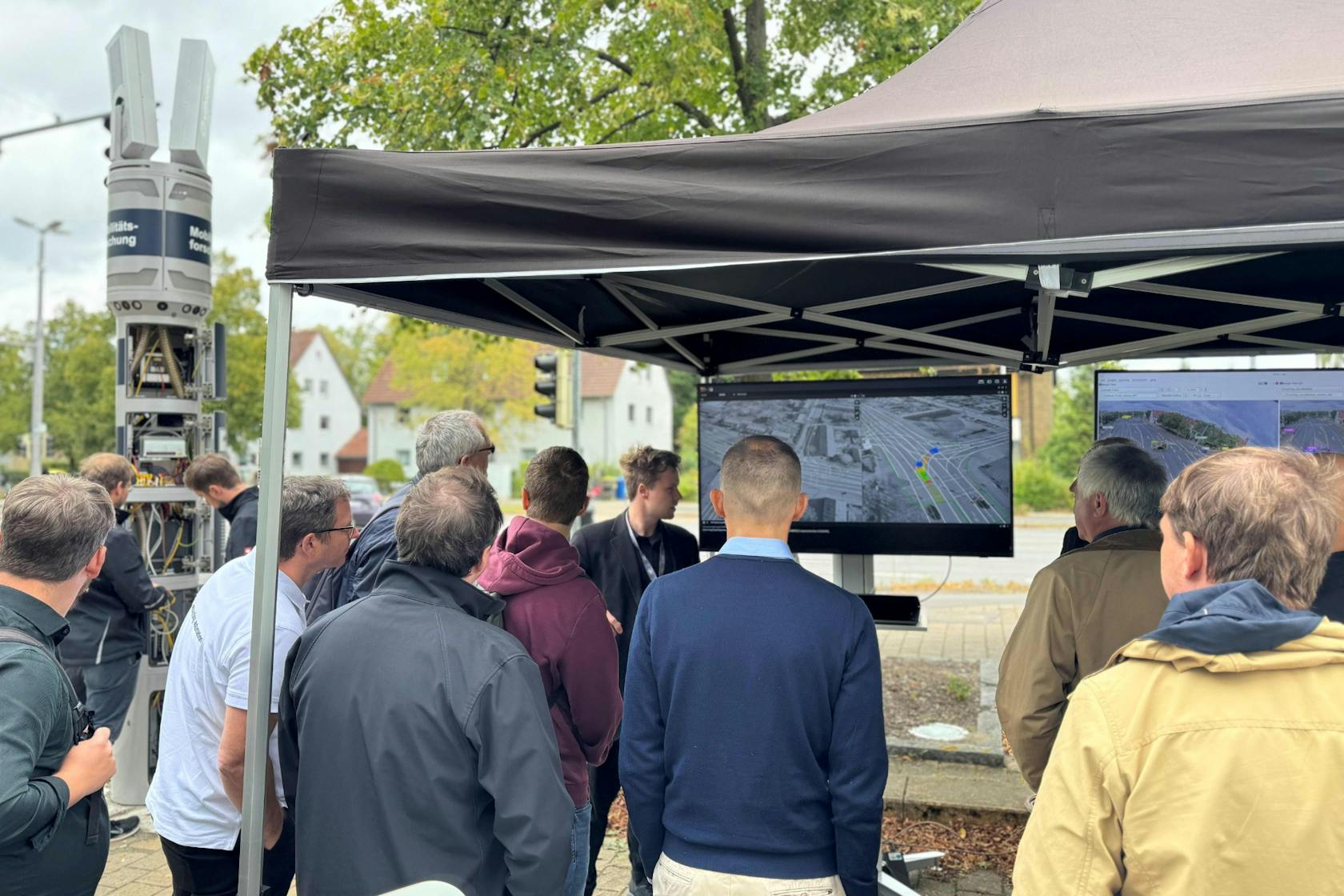
World Premiere in Braunschweig
At the final demonstration on Tostmannplatz in Braunschweig, the world saw for the first time how automated vehicles can be safely supported in real time by external sensors, technical supervision, and remote assistance—right in the middle of real city traffic.
The consortium thus demonstrated a possible future scenario for urban traffic: roads that “see” for themselves and actively guide vehicles. The result: greater safety, efficiency, and a crucial foundation for the next stage of automated mobility.
Sensors as the key to feasibility
At the heart of the system are stereo sensors developed by VITRONIC and Balluff, which are mounted on ITS traffic columns. They detect and classify all road users—pedestrians, cyclists, vehicles—in high resolution and in real time.
The sensors generate a precise digital image of traffic conditions that automated vehicles can use in real time – with latencies of less than 150 milliseconds.
The sensor technology developed in the project creates the basis for automated vehicles to be safely supported by the infrastructure for the first time. Our technology delivers the necessary precision – reliably, energy-efficiently, and in compliance with data protection regulations."
Presentation at EUCAD 2025
MAD Urban also attracted considerable international interest: even before the demonstration in Braunschweig, the consortium presented its findings at the European Conference on Connected and Automated Driving (EUCAD 2025) in Ispra, Italy. Here, experts from research, industry, and politics discussed the path to scalable, connected mobility solutions.
“With MAD Urban, we have shown that a vehicle can be guided entirely by external data – safely, cooperatively, and scalably. This brings the vision of connected, infrastructure-supported automation in urban traffic within reach,” said Richard Werner.
Outlook: from research to application
The research does not end with the conclusion of the project: the results form the basis for the next stage of development. In a follow-up project, VITRONIC is working together with DLR and other partners on a legal and technical framework that will enable the operation of infrastructure-based sensor systems in public spaces.
“The technology is ready—now the regulatory requirements must be created. Currently, the latest approval guidelines severely restrict the use of vehicle-external environmental data. In order to exploit the full potential of this approach, adapted, technology-neutral framework conditions will be needed in the future,” emphasizes Werner.
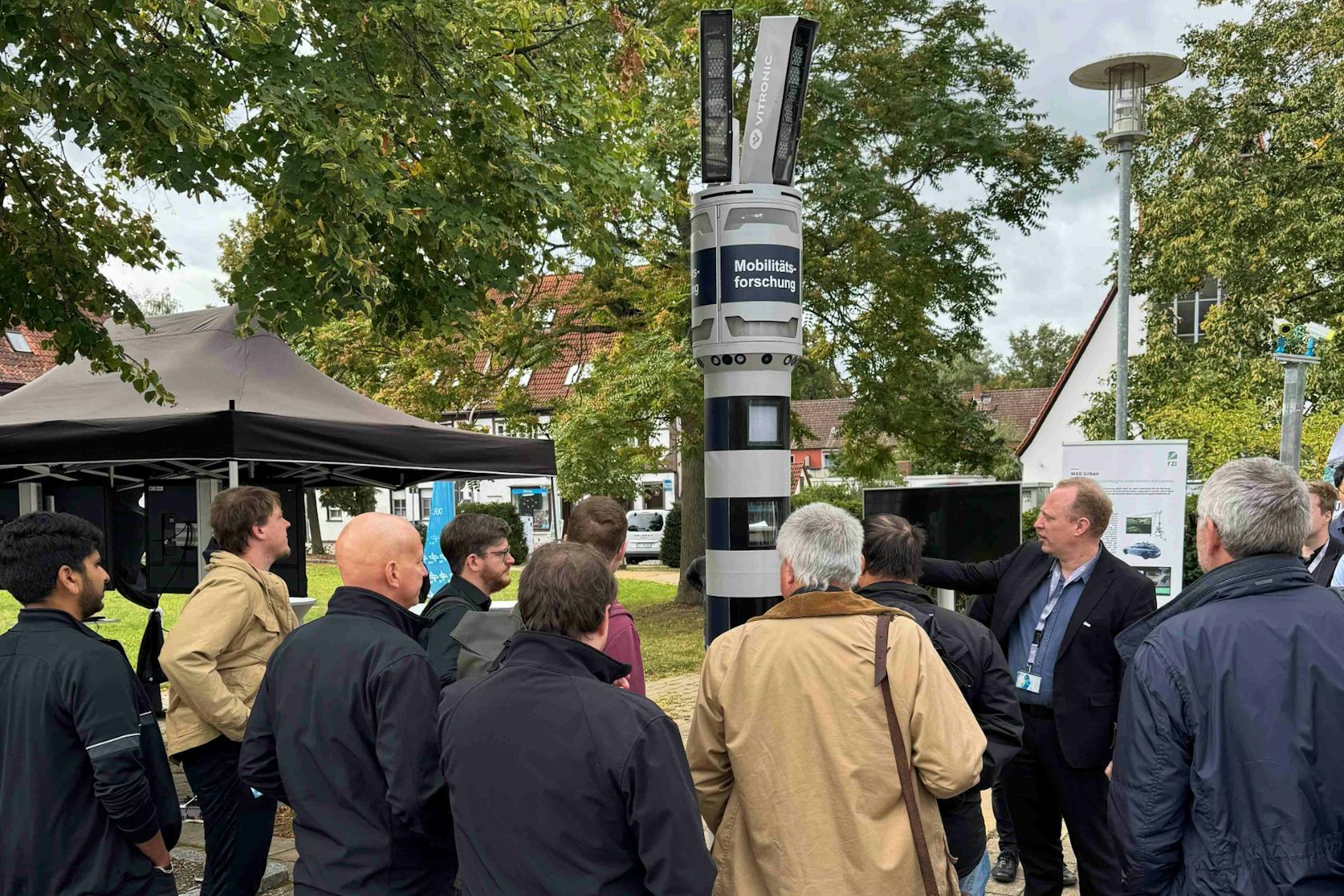
About MAD Urban
The MAD Urban – Managed Automated Driving in Urban Areas research project, funded by the BMWK, ran from 2022 to 2025. The aim was to develop and demonstrate a complete system for automated driving with infrastructure-based support. For the first time, sensor technology, data processing, communication, and technical supervision were combined into a continuous system and tested in real road conditions.
- Project Partners: German Aerospace Center (DLR, consortium lead)
- VITRONIC Machine Vision GmBH
- Balluff GmbH
- FZI Research Center for Information Technology
- GFT Technologies SE
- Intel Corporation
- Funding: Federal Ministry for Economic Affairs and Climate Action (BMWK)
- The MAD Urban approach explained in a video by the German Aerospace Center (DLR): Managed Automated Driving – a concept for cooperative autonomous driving
About VITRONIC
VITRONIC is the world's leading innovation driver for machine vision, enabling its customers to master the challenges of tomorrow.
The global group of companies develops forward-looking solutions in the form of specialized products and software for image-based quality inspection, identification and process optimization, which find application in the growth sectors of automation and traffic engineering.
VITRONIC solutions make an important contribution to helping shape a safe and sustainable world. The existing limits of what is economically feasible are constantly being questioned in order to achieve the highest quality and productivity, for example in the production of automotive and pharmaceutical companies. Worldwide, Auto-ID solutions in logistics centers and at cargo airports, take over the reliable and efficient recording of shipments and thus ensure a transparent flow of goods.
In the transport sector, VITRONIC offers leading technology for increased safety on the roads, for optimizing traffic flow and for recording road usage.
Open and honest dealings with our customers form the foundation for jointly exploiting technological and process potential to the full. Joint success forms the basis of long-term cooperation with companies such as B. Braun, BMW, Daimler, DHL, UPS, Fresenius and Sanofi as well as with public clients.
Since its foundation in 1984, VITRONIC has been growing continuously for 40 years. The current annual turnover (2025) is 231 million EUR and the company is currently represented on five continents in over 80 countries with approximately 1,400 employees. Since 2024 the company is part of ITIS Holding, leveraging the strengths of both entities, creating a strong end-to-end ITS and automation provider.
Development and production of VITRONIC systems are located at the company headquarters in Wiesbaden. VITRONIC subsidiaries span across all continents, including North and South America, Europe, Asia, Africa, and Oceania. Additionally, a global network of sales and service partners ensures localized support for international customers.